
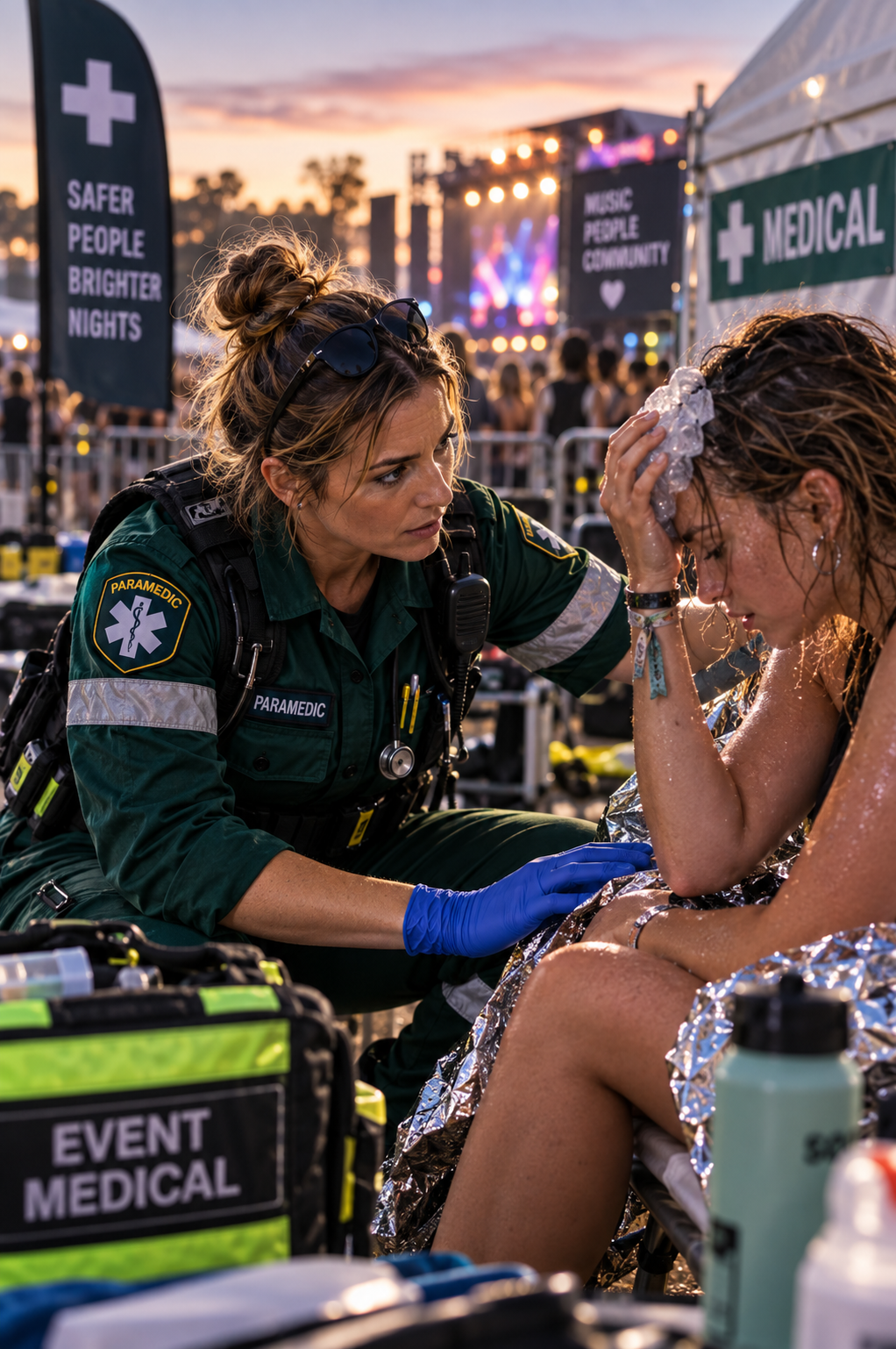
Festival and event emergencies
One-day course
Festival medicine creates an unusual clinical environment.
A medical centre may simultaneously contain: a dehydrated patron,
an intoxicated teenager,
a patient with MDMA-associated hyperthermia,
someone having a panic attack,
a laceration,
an asthma exacerbation,
and somebody asleep who their friends insist has "just had too much to drink."
Outside:
thousands of people are dancing.
The temperature is rising.
Communications are difficult.
Another patient is being brought from the crowd.
An ambulance may be some distance away.
And suddenly:
the apparently intoxicated patient stops responding.
Festival medicine therefore requires more than clinical knowledge.
It requires: triage; rapid assessment; toxicology; resuscitation; environmental medicine; minor injury care, communication; disposition; resource management and escalation.
The Festival & event emergencies programme develops clinicians capable of safely assessing, managing and escalating common and serious medical presentations encountered at music festivals, concerts and mass-gathering events.
It combines principles from: emergency medicine; prehospital care; toxicology; mass-gathering medicine; event health; harm reduction; environmental medicine; human factors and translates them into realistic event-based clinical practice.
By completion, participants should be able to:
• Explain how festival medicine differs from routine ambulance practice.
• Recognise common event-related medical presentations.
• Perform rapid clinical triage in an event environment.
• Identify patients requiring immediate resuscitation.
• Distinguish minor presentations from potentially serious illness.
• Undertake structured assessment despite noise, crowds and incomplete histories.
• Recognise alcohol and recreational-drug toxicity.
• Recognise important toxicological syndromes.
• Assess the patient with decreased consciousness.
• Recognise substance-related hyperthermia.
• Recognise dehydration and heat illness.
• Differentiate heat exhaustion from heat stroke.
• Recognise agitation and behavioural disturbance as potentially medical presentations.
• Recognise seizures and other neurological emergencies.
• Assess chest pain, dyspnoea and cardiovascular symptoms.
• Manage common respiratory presentations.
• Assess minor wounds, musculoskeletal injuries and soft-tissue trauma.
• Recognise when apparently minor trauma requires escalation.
• Recognise crowd-related compression and traumatic injury.
• Manage syncope and collapse.
• Recognise hypoglycaemia and other metabolic emergencies.
• Understand principles of harm reduction within clinical care.
• Communicate non-judgementally about alcohol and other drug use.
• Obtain useful drug histories despite uncertainty.
• Recognise the limitations of relying upon reported substance identity or dose.
• Determine when a patient requires observation.
• Recognise failure to improve.
• Determine when hospital transfer is required.
• Communicate effectively with onsite clinical teams, event control, ambulance services and receiving facilities.
• Manage multiple simultaneous patients.
• Recognise event-level clinical trends.
• Maintain situational awareness during periods of high demand.
• Apply effective team leadership and human-factors principles.
• Manage a major clinical emergency within an event medical facility.
Paramedics, nurses, doctors, event-health clinicians and other registered healthcare professionals providing clinical care at festivals, concerts and mass-gathering events.
Interactive lectures, workshops, case studies, group discussions and clinical scenarios.
Festival medicine - More than first aid
Event triage & the festival patient
Alcohol, recreational drugs & toxicity
Heat, hyperthermia, hydration & environmental illness
Altered consciousness, agitation & neurological emergencies
Medical emergencies in the crowd
Trauma, wounds & common festival presentations
Observation, discharge, transfer & escalation
Festival clinical skills
Festival medical centre simulation