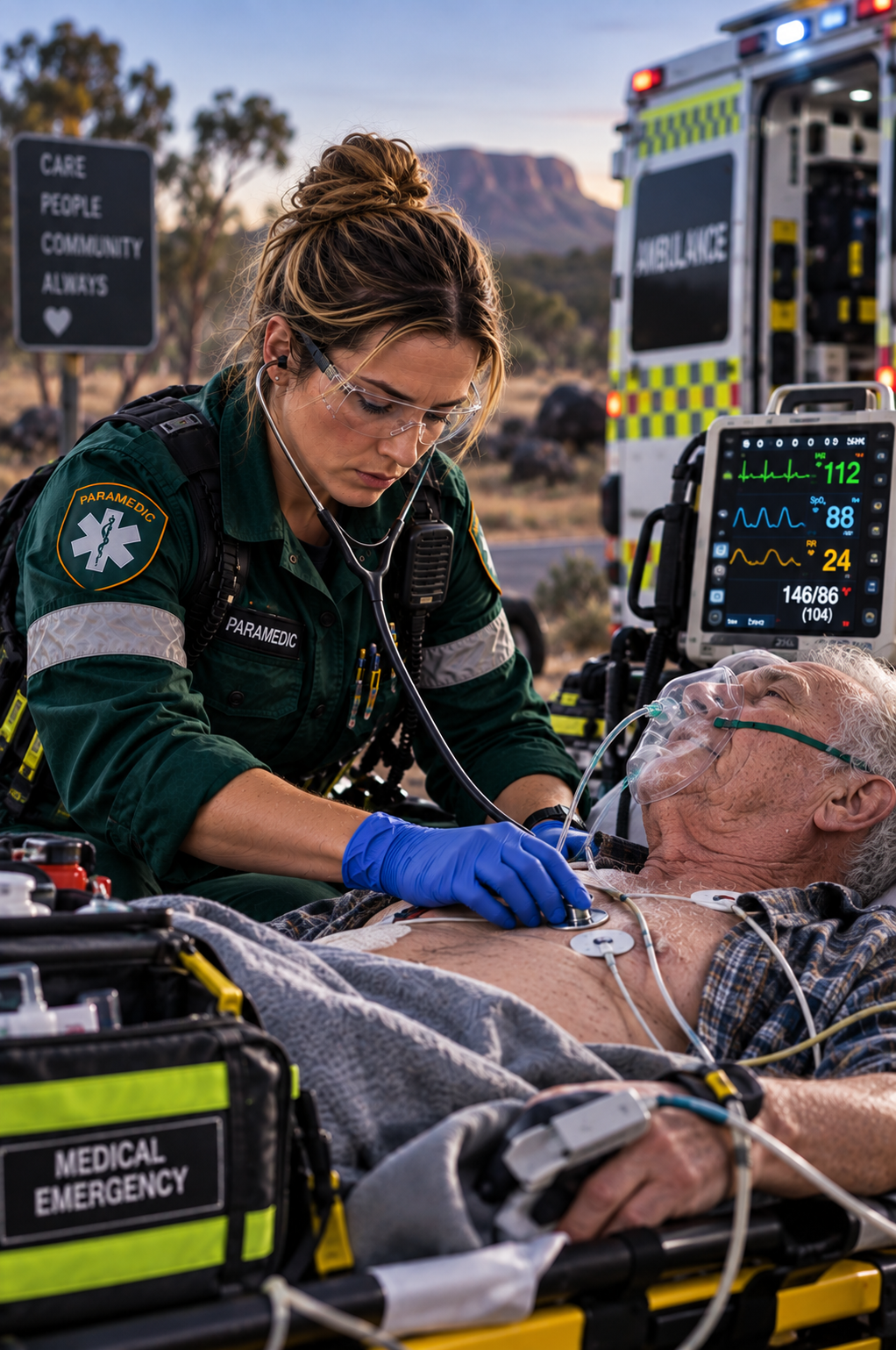
The Pre-Hospital Medical Emergencies Programme develops clinicians capable of assessing, differentiating, stabilising and managing patients presenting with common, serious and diagnostically challenging medical emergencies.
Rather than teaching isolated conditions, it integrates patient assessment, pathophysiology; differential diagnosis; clinical reasoning; pharmacology; procedural skills; reassessment; human factors; and transport decision-making.
The central question throughout both days is: What is happening to this patient - and what threatens them next?
By completion, participants should be able to:
• Rapidly recognise the critically unwell medical patient.
• Distinguish immediate resuscitation requirements from diagnostic assessment.
• Perform a structured medical assessment.
• Obtain a clinically useful history from an undifferentiated patient.
• Perform focused cardiovascular, respiratory, neurological and abdominal examination.
• Identify important positive and negative findings.
• Interpret clinical observations as trends rather than isolated numbers.
• Develop a prioritised differential diagnosis.Identify time-critical diagnoses that must not be missed.
• Recognise respiratory distress and respiratory failure.
• Differentiate oxygenation failure from ventilatory failure.
• Recognise and manage common obstructive respiratory emergencies.
• Recognise pulmonary oedema and other causes of acute dyspnoea.
• Recognise and manage anaphylaxis.
• Recognise sepsis and evolving septic shock.
• Differentiate major forms of shock.
• Recognise common causes of altered consciousness.
• Assess and manage seizures and status epilepticus.
• Recognise stroke and important stroke mimics.
• Perform a focused neurological assessment.
• Recognise diabetic and other metabolic emergencies.
• Assess the patient with acute abdominal pain.
• Recognise important gastrointestinal emergencies.
• Recognise renal and electrolyte-related emergencies.
• Understand the clinical importance of medication and polypharmacy.
• Recognise endocrine emergencies.
• Manage temperature-related medical emergencies.
• Recognise deterioration despite apparently reassuring observations.
• Evaluate response to treatment.
• Recognise when treatment is failing.
• Determine appropriate escalation, destination and transport priority.
• Communicate a concise clinical synthesis and handover.
• Manage diagnostic uncertainty.
• Recognise common cognitive and human-factor errors.
• Integrate assessment and management during medical simulations.
Paramedics, emergency nurses, retrieval clinicians and other healthcare professionals involved in the assessment and management of acutely unwell patients.
Interactive lectures, workshops, case studies, group discussions and clinical scenarios.
The Undifferentiated medical patient
Breathlessness: Respiratory distress & failure
Asthma, COPD & obstructive emergencies
Pulmonary oedema, PE & other causes of dyspnoea
Anaphylaxis & acute allergic emergencies
Sepsis, infection & the deteriorating patient
Shock: When perfusion fails
Altered consciousness & collapse
Neurological emergencies
Seizures & status epilepticus
Diabetic, endocrine & metabolic emergencies
Acute abdominal & gastrointestinal emergencies
Renal, electrolyte & haematological emergencies
The complex medical patient
Clinical reasoning & diagnostic uncertainty
Transport, escalation & safety-netting
Integrated medical emergency simulations